Goalball
Experience Sports Through Sound
Paralympic Sport for Vision-Impaired Athletes
What is Goalball?
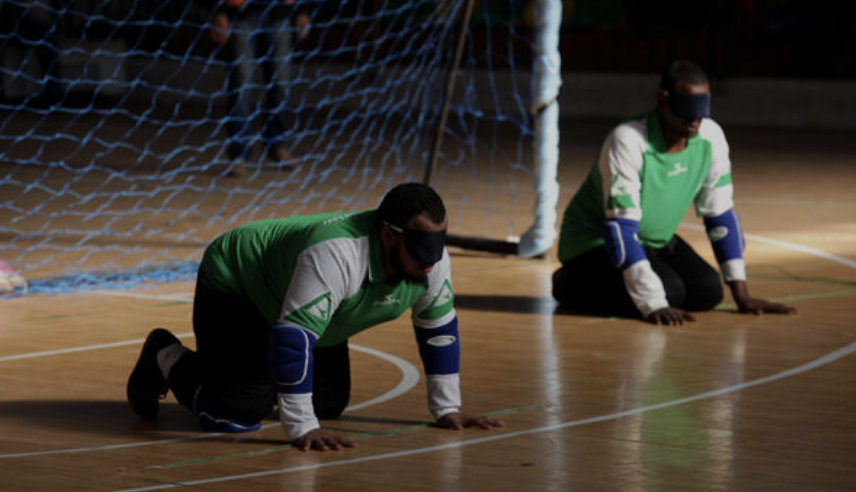
Goalball is a team sport designed specifically for athletes with a vision impairment. Participants compete in teams of three, and try to throw a ball that has bells embedded inside of it into the opponents' goal. The ball is thrown by hand and never kicked. Using ear-hand coordination, originating as a rehabilitation exercise, the sport has no able-bodied equivalent. Able-bodied athletes are also blindfolded when playing this sport.
Played indoors, usually on a volleyball court, games consist of twelve-minute halves (formerly ten-minute halves) with three-minute half-time. Players must use the sound of the bell to judge the position and movement of the ball. Eyeshades allow partially-sighted players to compete on an equal footing with blind players.
Team Size
3 players per team on court
Game Duration
Two 12-minute halves
Eyeshades
Required for all players
The Ball
1.25kg with bells inside
History
Goalball was originally devised in 1946 by Hans Lorenzen, an Austrian and Sepp Reindle, a German as a means of assisting the rehabilitation of visually impaired World War II veterans.
Goalball gradually evolved into a competitive game during the 1950s and 1960s. It was eventually nominated as a demonstration sport at the 1972 Summer Paralympics in Heidelberg, West Germany, and became a Paralympic Games sport at the 1976 Summer Paralympics in Toronto. The sport's first world championship was held in Austria in 1978.
As of 2017, there were 81 competing nations, and 270 international referees. The International Blind Sports Federation (IBSA), founded in 1981, is the official governing body for the sport.
Court and Ball Specifications
The Court
The Ball
Note: A lighter ball (0.9 kg) has been produced for younger players. Despite high ball speeds, there are very few injuries due to proper training and padding.
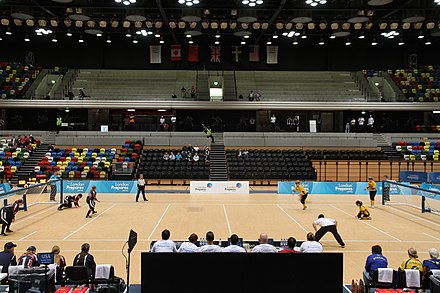
Goalball in action - Players defending their goal
Player Positions
Each team has three players on the court at a time, with one to three substitute players on the bench.
Centre Player
The most defensive position. Lines up at the centre orientation mark, further forward than the wings to avoid collisions. Responsible for defending both left and right sides, covering the greatest proportion of possible attacking shot lines.
May also serve as defensive coordinator and have an offensive role.
Left Wing
Lines up at the left sideline orientation mark. Main responsibility is keeping the ball out of the left corner, while also defending towards center. Typically a main offensive player due to advantageous shot angles.
Right Wing
Lines up at the right sideline orientation mark. Main responsibility is keeping the ball out of the right corner, while also defending towards center. Typically a main offensive player due to advantageous shot angles.
How the Game is Played
Offence
To score, a player must roll or bounce the ball down the length of the court, past the opposing defenders, and into the opponents' goal. The ball must hit in the player's own landing zone and anywhere in the neutral zone.
Technique: Players stand, orient themselves using tactile lines and sounds, stride forward, lean low, and roll or side arm the ball. Many elite players use spinning techniques or varied bounce patterns to deceive defenders.
Defence
Defending players stay within the team area in staggered positions. When they hear the other team throw the ball, they 'lay out' - sliding on their hips, stretching arms above their heads and extending legs to cover maximum distance.
Blocking methods: Some players block with their chest to absorb impact, others use their legs so the ball rolls up into their hands. The key is to make oneself as long as possible.
Critical Game Etiquette
The game relies heavily on the sense of hearing instead of sight, so ALL outside noise is prohibited.
NO cheering, clapping, chanting, or phone ringtones
Referees preface their call "Play!" with "Quiet, please!"
Coaches cannot speak while the ball is in play
All players wear blackened-out eyeshades that allow no light in, ensuring fairness
Scoring System
Goal: One point scored when ball completely crosses goal line
Overtime: If regulation ends in a tie, two 3-minute overtime periods with golden goal (first goal wins)
Penalty Shootout: If still tied, paired shootout and sudden death extra throws
Mercy Rule: Game ends when goal difference of ten is reached
Common Infractions & Penalties
Infractions (Loss of Possession)
Penalties (Penalty Throw Awarded)
Penalty defense: A single player must defend the entire goal for one throw. The player chosen depends on the penalty type.
Program Benefits
Our Goalball Program Highlights
Content information sourced from: Wikipedia - Goalball