
Rope Skipping / Jump Rope
Jump Your Way to Fitness, Fun & Competition
What is Rope Skipping / Jump Rope?
A skipping rope (British English) or jump rope (American English) is a tool used in the sport of skipping/jump rope where one or more participants jump over a rope swung so that it passes under their feet and over their heads.
There are multiple subsets of skipping/jump rope including: single freestyle, single speed, pairs, three person speed (double dutch), and three person freestyle (double dutch freestyle). The events are often separated by sex and age.
In freestyle events, jumpers use a variety of basic and advanced techniques in a routine of one minute, which is judged by a head judge, content judges, and performance judges. In speed events, a jumper alternates their feet with the rope going around the jumper every time one of their feet hit the ground for 30 seconds, one minute, or three minutes.
Sources: Wikipedia - Skipping Rope |Heart Foundation Australia
Suitable For
Ages 6 and up, all skill levels
Duration
1 hour per session
Group Size
15-30 participants
Equipment
All ropes provided
Correct Skipping Technique
Mastering the proper technique is essential for efficient and injury-free rope skipping:
1. Head
Held straight, looking ahead
2. Shoulders
Level and straight, not hunched
3. Arms
At about a 90° angle, held slightly forward and extended sideways
4. Wrists
Move in a circular wrist action to turn the rope
5. Elbows
Held in close to the body
6. Knees
Close together with a slight bend
Progressive Learning Levels
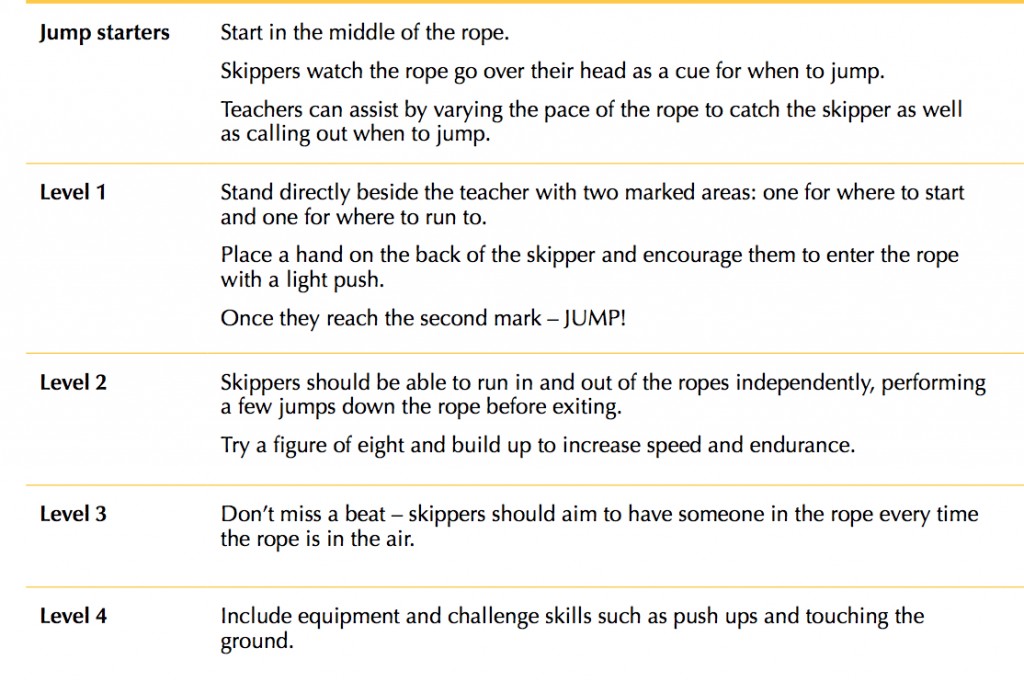
Jump Starters
- • Start in the middle of the rope
- • Skippers watch the rope go over their head as a cue for when to jump
- • Teachers can assist by varying the pace of the rope to catch the skipper as well as calling out when to jump
Level 1
- • Stand directly beside the teacher with two marked areas: one for where to start and one for where to run to
- • Place a hand on the back of the skipper and encourage them to enter the rope with a light push
- • Once they reach the second mark – JUMP!
Level 2
- • Skippers should be able to run in and out of the ropes independently, performing a few jumps down the rope before exiting
- • Try a figure of eight and build up to increase speed and endurance
Level 3
Don't miss a beat – skippers should aim to have someone in the rope every time the rope is in the air
Level 4
Include equipment and challenge skills such as push ups and touching the ground
Warm-Up & Preparatory Activities
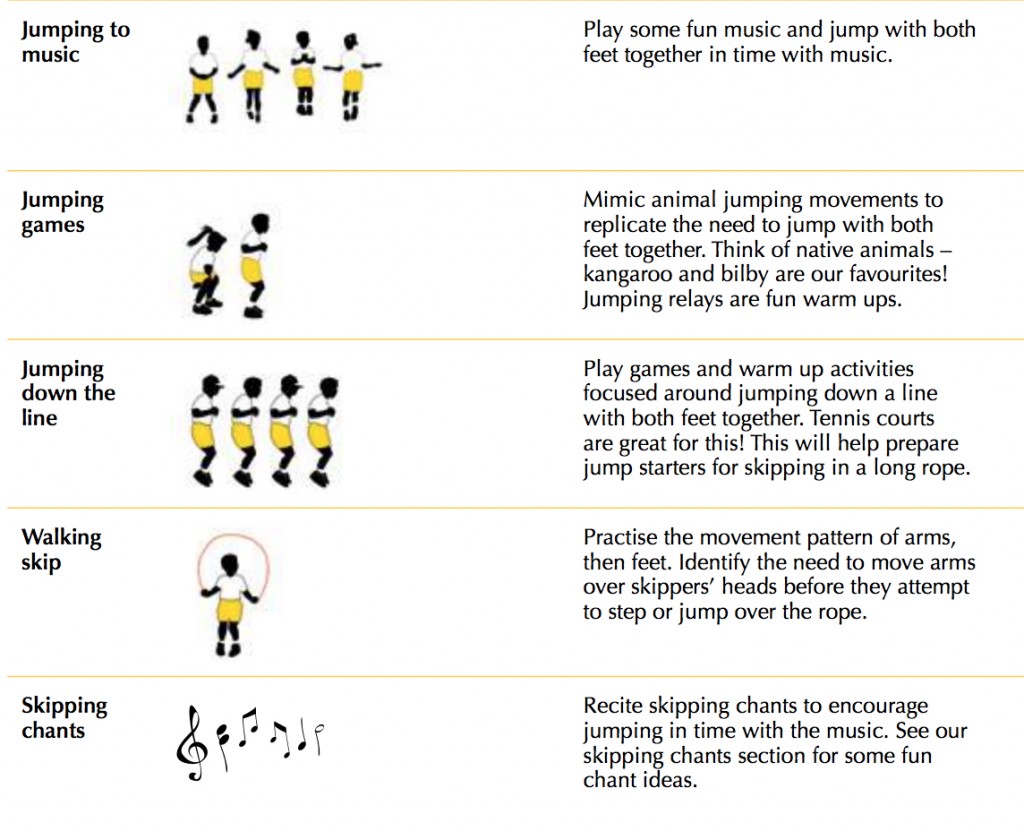
Jumping to Music
Play some fun music and jump with both feet together in time with music
Jumping Games
Mimic animal jumping movements to replicate the need to jump with both feet together. Think of native animals – kangaroo and bilby are our favourites! Jumping relays are fun warm ups
Jumping Down the Line
Play games and warm up activities focused around jumping down a line with both feet together. Tennis courts are great for this! This will help prepare jump starters for skipping in a long rope
Walking Skip
Practise the movement pattern of arms, then feet. Identify the need to move arms over skippers' heads before they attempt to step or jump over the rope
Skipping Chants
Recite skipping chants to encourage jumping in time with the music. See our skipping chants section for some fun chant ideas
Individual Skills & Techniques
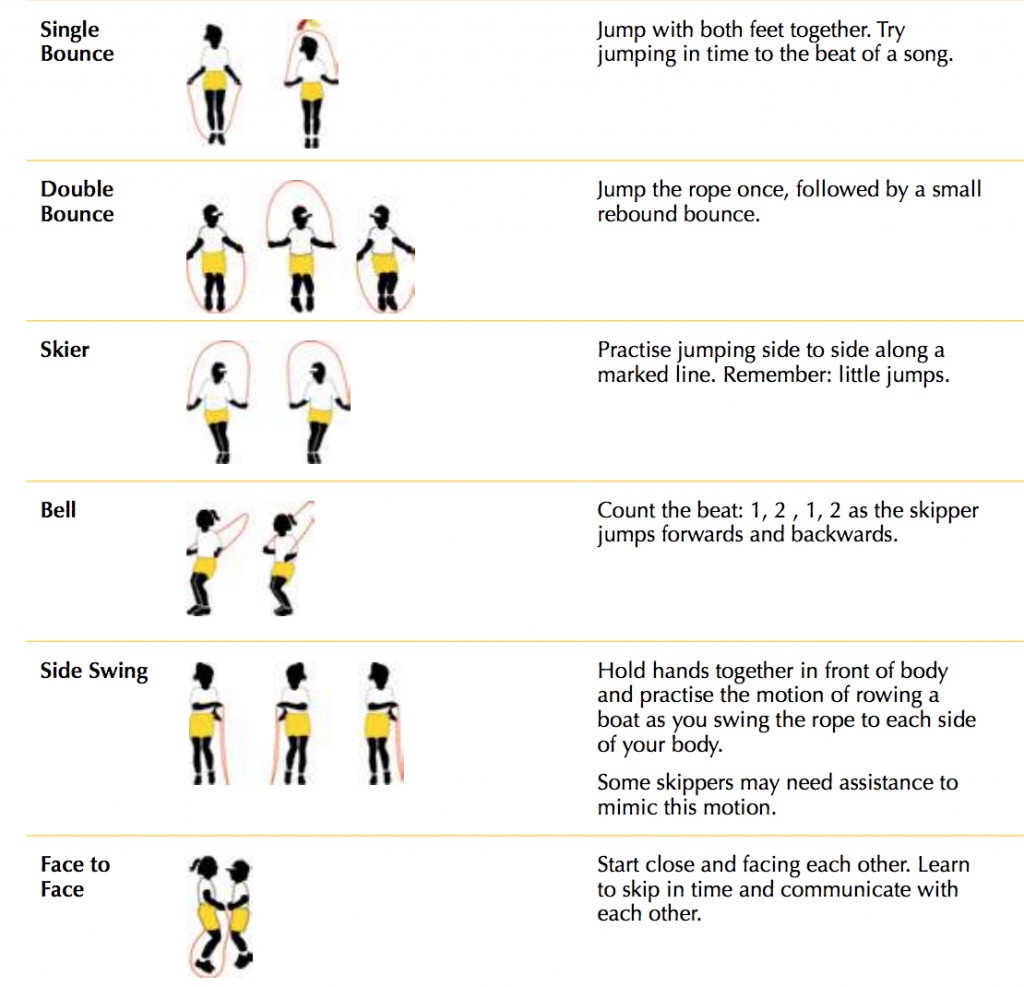
Single Bounce
Jump with both feet together. Try jumping in time to the beat of a song
Double Bounce
Jump the rope once, followed by a small rebound bounce
Skier
Practise jumping side to side along a marked line. Remember: little jumps
Bell
Count the beat: 1, 2, 1, 2 as the skipper jumps forwards and backwards
Side Swing
Hold hands together in front of body and practise the motion of rowing a boat as you swing the rope to each side of your body. Some skippers may need assistance to mimic this motion
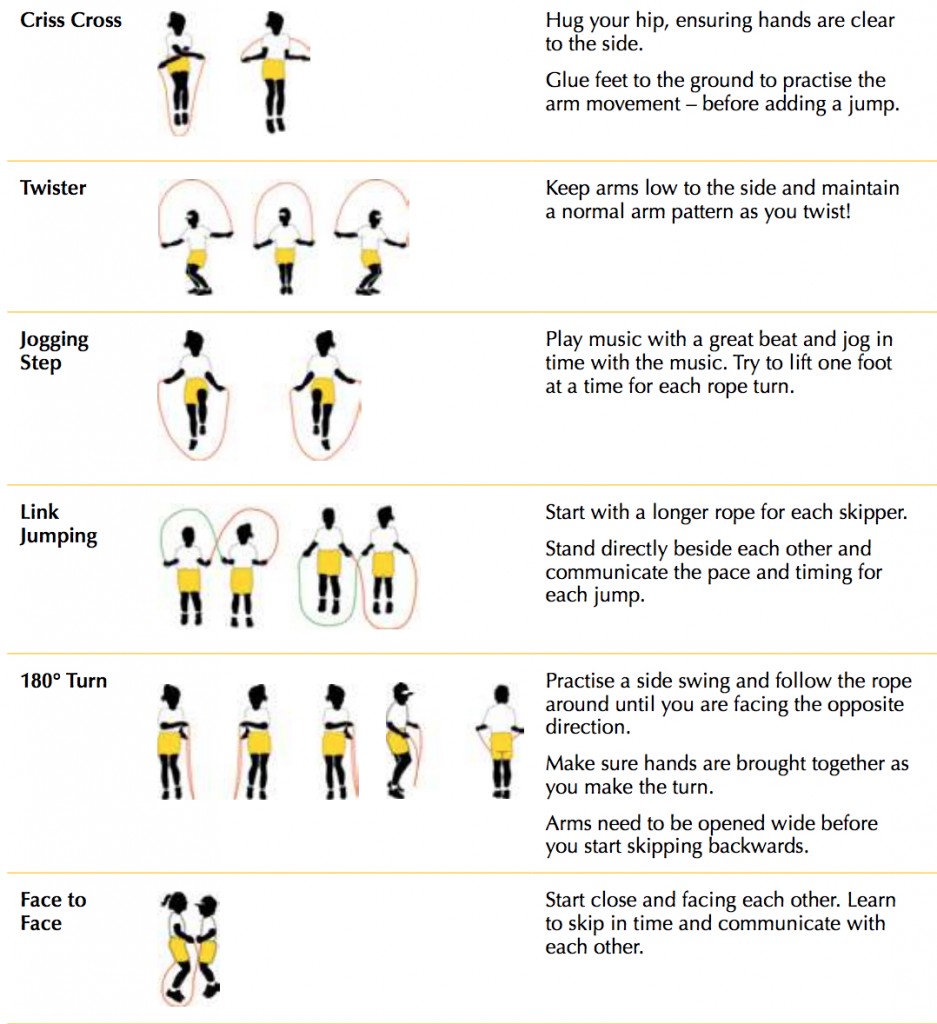
Criss Cross
Hug your hip, ensuring hands are clear to the side. Glue feet to the ground to practise the arm movement – before adding a jump
Twister
Keep arms low to the side and maintain a normal arm pattern as you twist!
Jogging Step
Play music with a great beat and jog in time with the music. Try to lift one foot at a time for each rope turn
180° Turn
Practise a side swing and follow the rope around until you are facing the opposite direction. Make sure hands are brought together as you make the turn. Arms need to be opened wide before you start skipping backwards
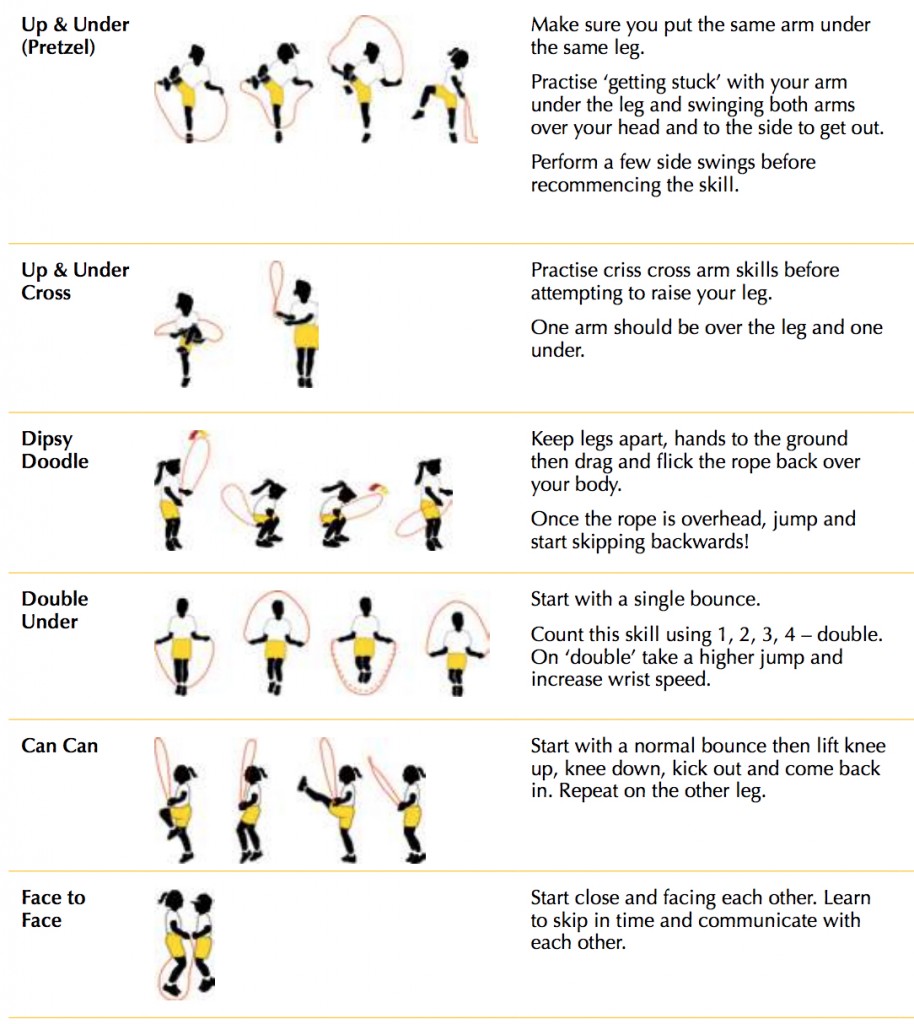
Up & Under (Pretzel)
Make sure you put the same arm under the same leg. Practise 'getting stuck' with your arm under the leg and swinging both arms over your head and to the side to get out. Perform a few side swings before recommencing the skill
Up & Under Cross
Practise criss cross arm skills before attempting to raise your leg. One arm should be over the leg and one under
Dipsy Doodle
Keep legs apart, hands to the ground then drag and flick the rope back over your body. Once the rope is overhead, jump and start skipping backwards!
Double Under
Start with a single bounce. Count this skill using 1, 2, 3, 4 – double. On 'double' take a higher jump and increase wrist speed
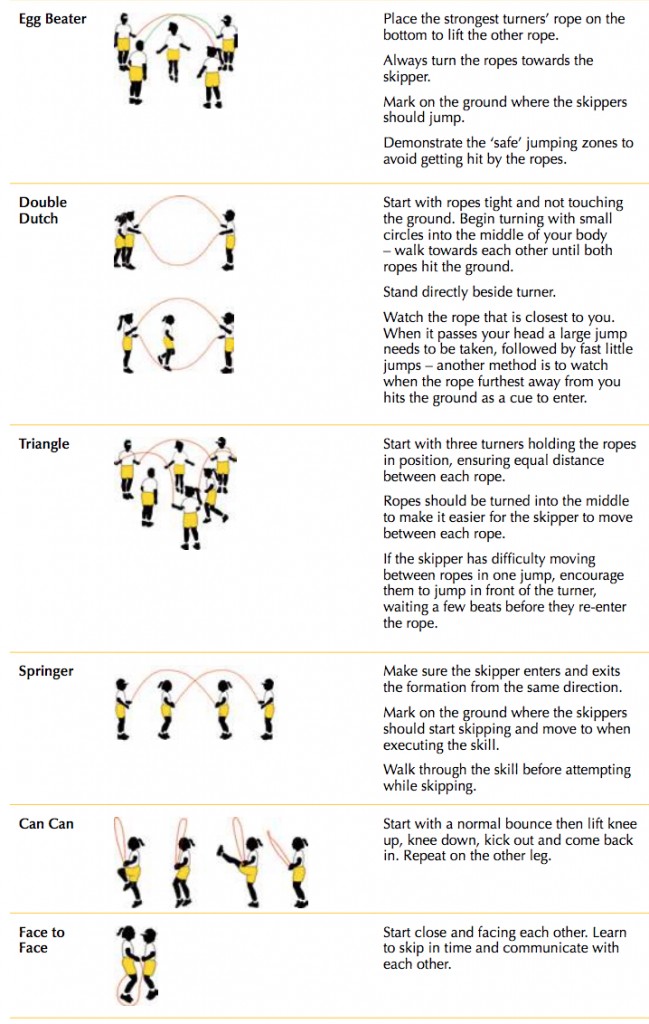
Can Can
Start with a normal bounce then lift knee up, knee down, kick out and come back in. Repeat on the other leg
Group & Partner Skills
Face to Face
Start close and facing each other. Learn to skip in time and communicate with each other
Link Jumping
Start with a longer rope for each skipper. Stand directly beside each other and communicate the pace and timing for each jump
Egg Beater
- • Place the strongest turners' rope on the bottom to lift the other rope
- • Always turn the ropes towards the skipper
- • Mark on the ground where the skippers should jump
- • Demonstrate the 'safe' jumping zones to avoid getting hit by the ropes
Double Dutch
- • Start with ropes tight and not touching the ground. Begin turning with small circles into the middle of your body – walk towards each other until both ropes hit the ground
- • Stand directly beside turner
- • Watch the rope that is closest to you. When it passes your head a large jump needs to be taken, followed by fast little jumps – another method is to watch when the rope furthest away from you hits the ground as a cue to enter
Triangle
- • Start with three turners holding the ropes in position, ensuring equal distance between each rope
- • Ropes should be turned into the middle to make it easier for the skipper to move between each rope
- • If the skipper has difficulty moving between ropes in one jump, encourage them to jump in front of the turner, waiting a few beats before they re-enter the rope
Springer
- • Make sure the skipper enters and exits the formation from the same direction
- • Mark on the ground where the skippers should start skipping and move to when executing the skill
- • Walk through the skill before attempting while skipping
Our comprehensive rope skipping programme - from beginners to advanced competitive skills