
Warm Up Games
Energizing Group Activities
About Warm Up Games
A collection of fun, energetic games designed to warm up participants and build group dynamics. These activities get everyone moving, laughing, and working together.
Perfect as ice-breakers, energizers, or standalone programs for schools, corporate groups, and community events. Our extensive game library ensures variety and engagement for all ages.
Suitable For
Ages 5 and up
Duration
30 minutes - 1 hour
Group Size
15-50 participants
Equipment
Minimal required
Complete Games Catalog
Dog and Bone
Min Group Size: 12 (split into 2 teams)
Equipment: 1 ball/beanbag
Split the group in two with one group on each side of the playing area along a line. Place a ball/beanbag (the bone) in the middle of the playing area. Each team must be numbered 1 to 12 (change this depending on group size). The instructor shouts a number and the two people with that number (on opposite teams) must try to get the bone before the other one. When one gets the bone, the other can try to tag them before they get back to their team line. The team scores points depending on how many times they manage to get the bone. You can mix it up by choosing different numbers on each team to go against each other.
Everybody's It
Min Group Size: 6
Equipment: None
Good warm up game. Everyone in the group is it and they must try and tag each other, if they get caught they must stand still with both hands in the air, the only way to free them is for another person to give them a high 10 and then the game continues.
Man the Lifeboats
Min Group Size: 8
Equipment: None
A fun and energetic game for younger children. The leader shouts commands in which the group have to action as quickly as possible – the last person to complete the action is out of the game. To play the game, name four sides of the room bow (front of the room), stern (back of the room), starboard (right side) and port (left side). The leader shouts these commands out in any order and the group have to run to side called out. If you say, 'man the lifeboats', everyone must sit on the floor.
Commands:
- • 'Boom coming over' – Participants lie flat on the floor, hand clasping their heads
- • 'Captain coming' – Stand to attention and salute
- • 'Climb the rigging' – Mime climbing ropes
- • 'Man overboard' – Grab a partner
- • '2, 3 or 4 in a boat' – In groups of 2, 3 or 4, participants sit down and mime rowing a boat
Cat and Mouse
Min Group Size: 12
Equipment: Numbered paper
One person is the cat and the rest are mice. The mice run around in the meadow until the cat meows. When this happens, the mice must run and get on a piece of numbered newspaper to be safe. The numbers of that piece of newspaper indicate the maximum number of mice allowed to stand on the paper. Any mouse with no home becomes a cat.
Fishy Fishy Sharky Sharky
Min Group Size: 8
Equipment: None
The leader selects a shark from the group. Everyone else must then line up at the other end of an allocated area. The shark decides who to call forward (e.g., 'anyone wearing red' or 'anyone wearing a hat'). Those chosen run to the opposite end of the allocated space, past the shark who will try to catch them. If the shark catches them, they then become seaweed. As seaweed, children cannot move their feet but they can reach out with their arms to catch others. The game continues with anyone the shark or seaweed catches becoming seaweed. The last person in becomes the shark in the next game.
Variation:
The Sharks shout 'Fishy, fishy, fishy, come swim in my sea!' and the Fish reply 'Sharky, sharky, sharky, you can't catch me!' The Fish then have to run to the other side without getting caught by a shark.
Freeze Tag
Min Group Size: 12
Equipment: 2 different colored balls
Similar to 'stuck in the mud'. During the game there are two different colored balls and two ball carriers are selected from the group. The blue ball carrier can freeze people by touching them with the ball. The yellow ball unfreezes. When the yellow ball is handed to someone who is frozen, they defrost and become the yellow ball carrier instead. The blue ball carrier stays the same throughout the game. More than one of the same colored ball can be added during the game to make this a faster paced game.
Mirroring
Min Group Size: 2 (pairs)
Equipment: None
Split the group into pairs and organize them so they are standing opposite each other. One person makes a movement, the other tries to mirror them as well as they can, they then continue this for the time allocated (say a minute). Swap roles. When both have played both roles, they can try to coordinate movements with each other, so that both become player and mirror at the same time. This works best with slow movements and needs a lot of concentration.
Tip: You can use this to help practice certain movements for sports e.g. passing the ball, en-guarde for Fencing, kicks for Karate etc.
Vary Your Speed
Min Group Size: 10
Equipment: None
Participants pick a spot on the floor some distance away and focus on it. When the game starts, they must walk towards the spot in a straight line. The object is to reach your spot on the floor without coming into contact with any other person. You may not stop or change direction but you may alter speed. This game is great for group awareness.
Dodgeball
Min Group Size: 12
Equipment: Soft play ball, cones (if outside)
A child is selected by the leader to be the 'Dodgeball Master'. The object of the game is for all other children to try to get from one safe zone to the other. While the group tries to get from one side to the other, the Dodgeball Master removes members by throwing the ball underhand and then trying to hit the legs of the group members. Once a participant has been hit, they are considered out and then become a judge.
Tip: Remain vigilant and ensure the dodgeball master is only throwing the ball underarm and towards the legs of the challengers.
Touch Blue
Min Group Size: 8
Equipment: Various colored items
Participants must find an object or item of clothing pertaining to a specific color in which they are told. However, they cannot touch anything on themselves or on another person. The last person to touch the color is out of the game. To make this game difficult, it's best to only use unusual colors or patterns, making the children run further to reach the objects. They will be provided an opportunity to use their creative thinking skills.
Deflector Bomb
Min Group Size: 10
Equipment: None
Participants pick two people from the group: one person is the bomb and the other the deflector shield. The object is to keep the deflector shield between you and the bomb without revealing which is which to the rest of the group. At the end of a given time (say 1 minute) the game stops and you see at that moment who has their deflector shield in between them and their bomb. If they fail to protect themselves from the bomb then they sit out the rest of the game.
How to Play:
Everyone must secretly choose another person in the group who is their bomb (who will explode if they get close to them). They must then secretly choose someone who is their shield (who will protect them from their bomb). The group must then move around within a specified area ensuring they always keep their shield between them and their bomb. After a certain amount of time, shout 'BANG' and all those who are blown up by their bomb (i.e. do not have their shield protecting them) must fall to the floor.
Buzzy Bee
Min Group Size: 12
Equipment: None
The children get into pairs. They then run around separately, buzzing and pretending to be bees. The person nominated to be 'it' shouts, 'Buzzy bee, buzzy bee touch [body part]'. After this phrase is said, the participants run back and find their partners. Whichever body part has been called out, they must touch together. e.g. 'touch knees', they have to touch their knees together.
Ladders
Min Group Size: 8 (even numbers only)
Equipment: None
Pair up the group members and sit them down, with legs flat, leaving space between pairs to prevent injury from occurring. Give each pair a number starting from the number one. Once all pairs have a number, you then call a number and that pair will jump up, step over the other pairs legs one at a time then run round the whole of their team and sit back down in their original place. The first one to sit back in place is the winner. Alternatively, you can play as a team. After the first pair has completed their turn, the next person gets up and runs, until the whole team have been and the leader declares a winning team.
Bump Tag
Min Group Size: 10
Equipment: None
The leader selects a cat and a mouse from the group. The aim of the game is for the cat to chase the mouse. If the cat manages to catch the mouse they then become the cat and have to do the chasing. Everyone else in the group pairs up and stands side-by-side spread out in the activity area. The mouse changes throughout the game by the mouse linking to the side of a pair, the person on the opposite side to where the mouse has linked themselves then becomes the mouse and the cat has to chase them instead.
Giants, Wizards and Dwarfs
Min Group Size: 6
Equipment: None
This is a giant team game of rock, paper, scissors. Divide the group into two teams. Define a playing area with two end safety zones and a middle line. Each team decides their character and approaches the middle line. On the count of three the teams perform the action and noise (which signifies their character). The winning team pursues the losing team and tries to tag them before they make their safety zone. Any person tagged joins the opposite team. This continues until one team has all the players.
Rules:
As in rock, paper, scissors each character beats one other: Wizard beats the Dwarf by casting a spell on him; Giant beats the Wizard by crushing him; Dwarf beats the Giant by tickling his feet.
Traffic Lights
Min Group Size: 8
Equipment: None
An easy warm-up game for children to play, which is ideal for younger children. On the word 'red', the children must stand very still. On the word 'amber', they can walk around. On the word 'green', they should run. If any of the participants do the wrong thing at the wrong time, they are out of the game and act as a judge for the remainder of the game. The leader of this game can make things confusing by shouting 'Speed camera' (slow motion), 'roundabout' (sit and spin), etc.
Fruit Salad
Min Group Size: 10 (even number)
Equipment: None
Children pair up and each pair chooses a different type of fruit. They then stand opposite each other in two lines (similar to line dancing) and make a tunnel with their hands. The leader then calls out fruit names randomly. Once a pair's fruit has been called, they run through the tunnel, then back round the outside and race back to their original places. This can be made more interesting by using animals and making the noise of the animal rather than calling out just the name. You can also make it competitive by making each line one team and scoring the winning participant from each race.
Jack in the Box
Min Group Size: 8
Equipment: None
Choose one person to be the leader; everyone else must stand in a circle around them. When the leader shouts, 'Jack in the box' participants must squat down. When the leader shouts 'Jack out of the box' participants must all jump up. The leader can repeat the commands, say them fast or slow in an attempt to confuse the children. Anyone who does the wrong action is then out of the game.
Stuck in the Mud
Min Group Size: 10
Equipment: None
In a boundary area, one person is 'it'. They must then run around trying to tag as many people as they can. Once a person has been caught, they then have to stand with feet shoulder width apart and can only be freed if someone crawls between their legs.
Over Under Race
Min Group Size: 8 (even number)
Equipment: 2 balls
The group is split into two equal teams and each team should form a straight line. Each team is given a ball. The person at the front of the line passes the ball over their head followed by the person behind them taking the ball and passing it through their own legs to the next person. The ball continues going over then under until it reaches the person at the back of the line. The person at the back takes the ball and runs to the front of the line where the process starts again. In order to complete the challenge, all team members must have a turn with the team that returns to their starting order the quickest winning the game.
Variation:
Tunnel Ball - In this game the ball is rolled through the legs of all the team members until the person at the back catches it and runs to the front of the line, where the process begins again.
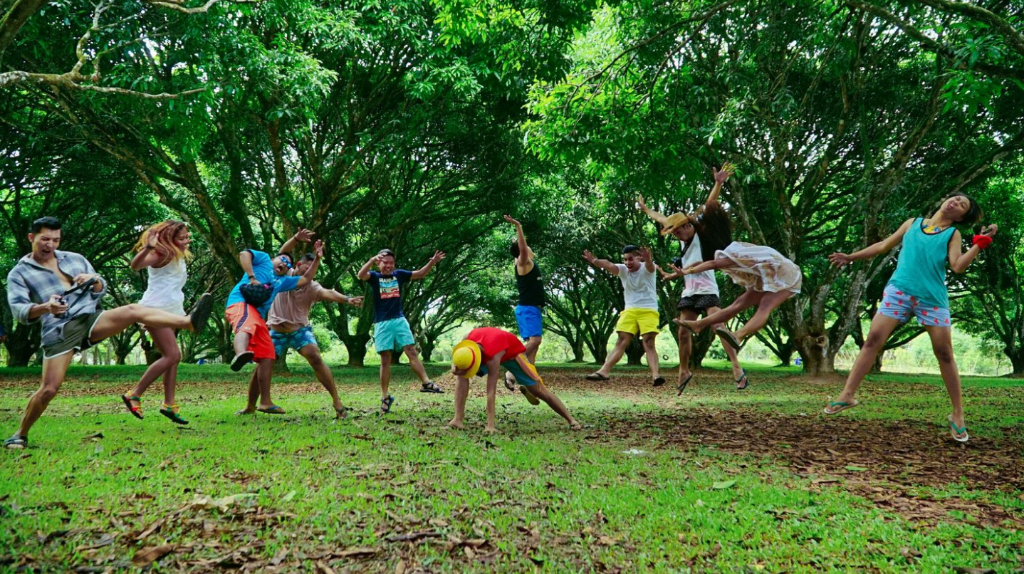
Our extensive collection of warm-up games for all ages and group sizes
Programme Benefits
Programme Highlights
Source: Venture Team Building - Free Team Building Activities, Problem Solving Challenges