
Taekwondo
The Art of Discipline & Respect
Our Non-Contact Taekwondo Program
Our Taekwondo program is specifically designed as a NON-CONTACT programme, focusing on technique development, forms (poomsae), fundamental movements, and character building without full-contact sparring. This makes it safe and accessible for all ages while developing essential martial arts skills and values.
What is Taekwondo?
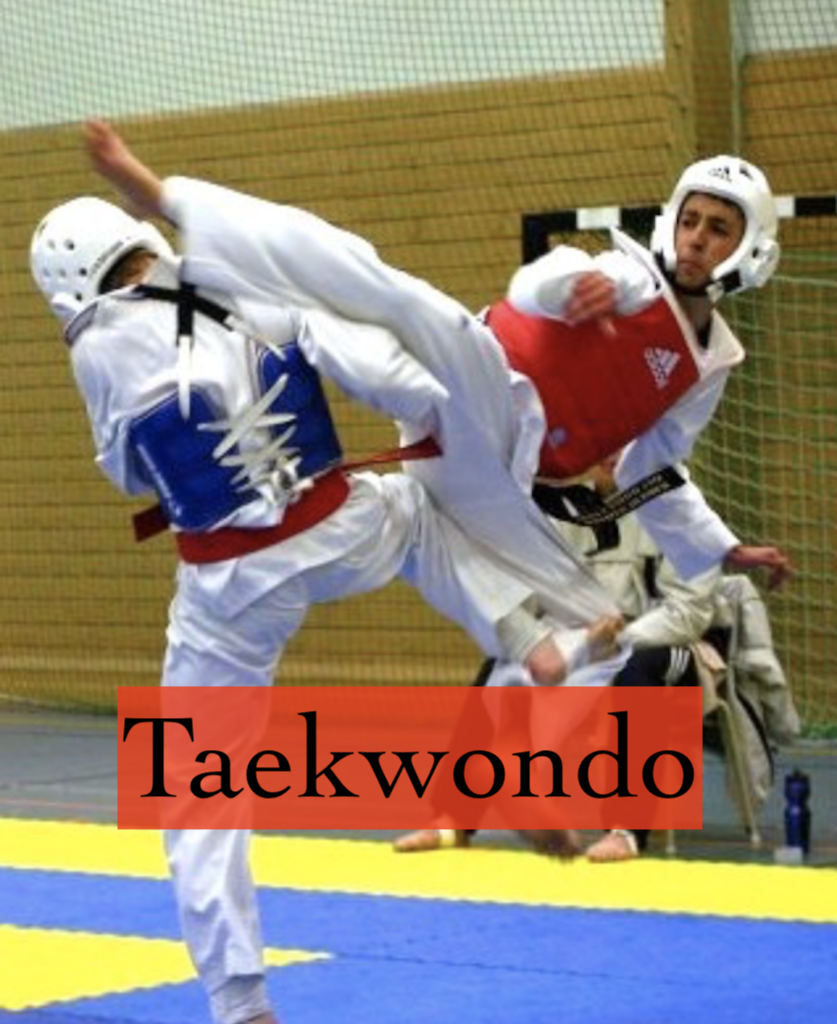
Taekwondo, Tae Kwon Do or Taekwon-Do (Korean 태권도/跆拳道) is a Korean martial art, characterized by its emphasis on head-height kicks, jumping and spinning kicks, and fast kicking techniques.
Taekwondo is a combative sport and was developed during the 1940s and 1950s by Korean martial artists with experience in martial arts such as karate, Chinese martial arts, and indigenous Korean martial arts traditions such as Taekkyon, Subak, and Gwonbeop.
The oldest governing body for Taekwondo is the Korea Taekwondo Association (KTA), formed in 1959. The main international organizational bodies for Taekwondo today are the International Taekwon-Do Federation (ITF)and World Taekwondo (WT), which governs Taekwondo in the Olympics and Paralympics.
Source: Wikipedia - Taekwondo
Suitable For
Ages 5 and up
Duration
1-2 hours per session
Group Size
15-30 participants
Equipment
Training pads provided
Skill Sets Developed Through Our Taekwondo Program
1. COMMUNICATION
Participants develop group environmental awareness, developing social skills and promoting interaction with others.
2. CONFIDENCE
Over time, participants are empowered with skills to defend themselves. With this belief in themselves, a corresponding increase in confidence will spill over into all areas of life.
3. FOCUS & CONCENTRATION
Participants are trained to pay attention to their instructor, and improving concentration skills to distinguish what is relevant, even when it comes to small details, and ignoring distractions.
4. DISCIPLINE
Participants are taught the value of doing what is right, even when no one is watching. A disciplined student is willing to put in the effort and train through repetition to improve or accomplish a goal.
5. RESPECT
Students are expected to demonstrate respect to their instructors and fellow students, and to be honourable and show kindness to others regardless of the situation.
6. HONESTY
Participants are taught to value truthfulness, thereby creating trust.
Characteristics of Taekwondo
Taekwondo is characterized by its emphasis on head-height kicks, jumping and spinning kicks, and fast kicking techniques. In fact, World Taekwondo sparring competitions award additional points for strikes that incorporate spinning kicks, kicks to the head, or both.
To facilitate fast, turning kicks, Taekwondo generally adopts stances that are narrower and taller than the broader, wide stances used by martial arts such as karate. The tradeoff of decreased stability is believed to be worth the commensurate increase in agility.
Theory of Power
The emphasis on speed and agility is a defining characteristic of Taekwondo and has its origins in analyses undertaken by Choi Hong Hi. The results of that analysis are known as Choi's Theory of Power.
Choi based his understanding of power on biomechanics and Newtonian physics. For example, he observed that the kinetic energy of a strike increases quadratically with the speed of the strike, but increases only linearly with the mass of the striking object. In other words, speed is more important than size in terms of generating power.
Components of the Theory of Power:
Reaction Force
As the striking limb is brought forward, other parts of the body should be brought backwards to provide more power
Concentration
Bringing as many muscles as possible to bear on a strike, concentrating the impact area into as small a space as possible
Equilibrium
Maintaining a correct centre-of-balance throughout a technique
Breath Control
During a strike one should exhale, with the exhalation concluding at the moment of impact
Mass
Bringing as much of the body to bear on a strike as possible, such as rotating the hip during a kick
Speed
Speed of execution is deemed to be even more important than mass in terms of providing power
Typical Curriculum
While organizations such as ITF or Kukkiwon define the general style of Taekwondo, individual clubs and schools tend to tailor their practices. A student typically takes part in most or all of the following:
Forms (Poomsae / Hyeong / Tul)
These serve the same function as kata in karate, teaching patterns of movement, technique, and principles
Fundamental Techniques
Learning kicks, blocks, punches, and strikes, with emphasis on kicking techniques and somewhat less on grappling
Breaking (Gyeokpa)
The breaking of boards for testing, training, and demonstrations using power breaking, speed breaking, and special techniques
Self-Defense Techniques (Hosinsul)
Practical self-defense applications and techniques
Physical Conditioning
Both anaerobic and aerobic workout, including stretching, flexibility training, and strength building
Mental & Ethical Training
Relaxation and meditation exercises, breathing control, focus on mental and ethical discipline, etiquette, justice, respect, and self-confidence
Belt Progression & Examinations
Examinations to progress to the next rank, with development of personal success and leadership skills
Our Non-Contact Taekwondo Programme - Building Character, Discipline, and Skills