
Kampung Games
Traditional Games & Fundamental Movement Skills
Fundamental Movement Skills Through Play
Fundamental movement skills (FMS) form the building blocks of daily activities and are essential in the early years to pave the way for development of more complex physical movements.
Build your child's Object Control skills (e.g., throwing, catching, kicking, dribbling with foot) to control an object using a part of the body or using an implement. Build your child's Stability skills (e.g., static balance, dynamic balance, bending, turning, twisting) to maintain and acquire balance.
We encourage parents to participate actively in the activities and enjoy the fun together with your child!
Source: HealthHub.sg & SportSG
Suitable For
Ages 4-12
Duration
1-2 hours per session
Group Size
15-30 participants
Equipment
All games provided
Game 1: Kampung Fiesta
Number of Players
5 or more
Items Needed
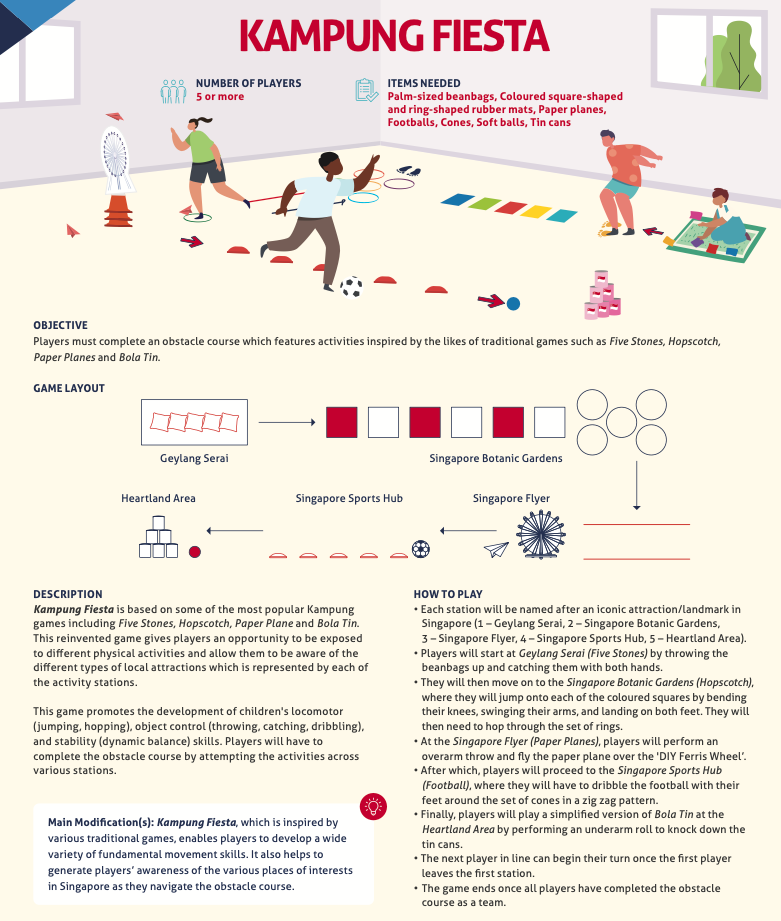
Palm-sized beanbags, Coloured square-shaped and ring-shaped rubber mats, Paper planes, Footballs, Cones, Soft balls, Tin cans
Objective
Players must complete an obstacle course which features activities inspired by the likes of traditional games such as Five Stones, Hopscotch, Paper Planes and Bola Tin.
Description
Kampung Fiesta is based on some of the most popular Kampung games including Five Stones, Hopscotch, Paper Plane and Bola Tin. This reinvented game gives players an opportunity to be exposed to different physical activities and allow them to be aware of the different types of local attractions which the game is based on.
This game promotes the development of children's locomotor (jumping, hopping), object control (throwing, catching, dribbling), and stability (dynamic balance) skills. Players will have to complete the obstacle course by attempting the activities across various stations.
How to Play
- • Each station will be named after an iconic attraction/landmark in Singapore (e.g., Geylang Serai, Singapore Botanic Gardens, Singapore Flyer, Singapore Sports Hub, Heartland Area)
- • Players will start at Geylang Serai (Five Stones) by throwing the beanbags up and catching them with both hands
- • They will then move on to the Singapore Botanic Gardens (Hopscotch), where they jump onto each coloured square by bending their knees, swinging their arms, and landing on both feet. They will then need to hop through the set of rings
- • At the Singapore Flyer, players will perform an overarm throw and fly the paper plane over the 'DIY Ferris Wheel'
- • After which, players will proceed to the Singapore Sports Hub (Football), where they will have to dribble the football with their feet using a zig zag pattern
- • Finally, players will play a simplified version of Bola Tin at the Heartland Area by performing an underarm roll to knock down all the tin cans
- • The next player in line can begin their turn once the first player leaves the first station
- • The game ends once all players have completed the obstacle course as a team
Main Modification(s):
Kampung Fiesta, which is inspired by various traditional games, enables players to develop a wide variety of fundamental movement skills. It also helps to generate players' awareness of the various places of interests in Singapore as they navigate the obstacle course.
Game 2: Rollie Pollie Game
Number of Players
7 or more
Items Needed
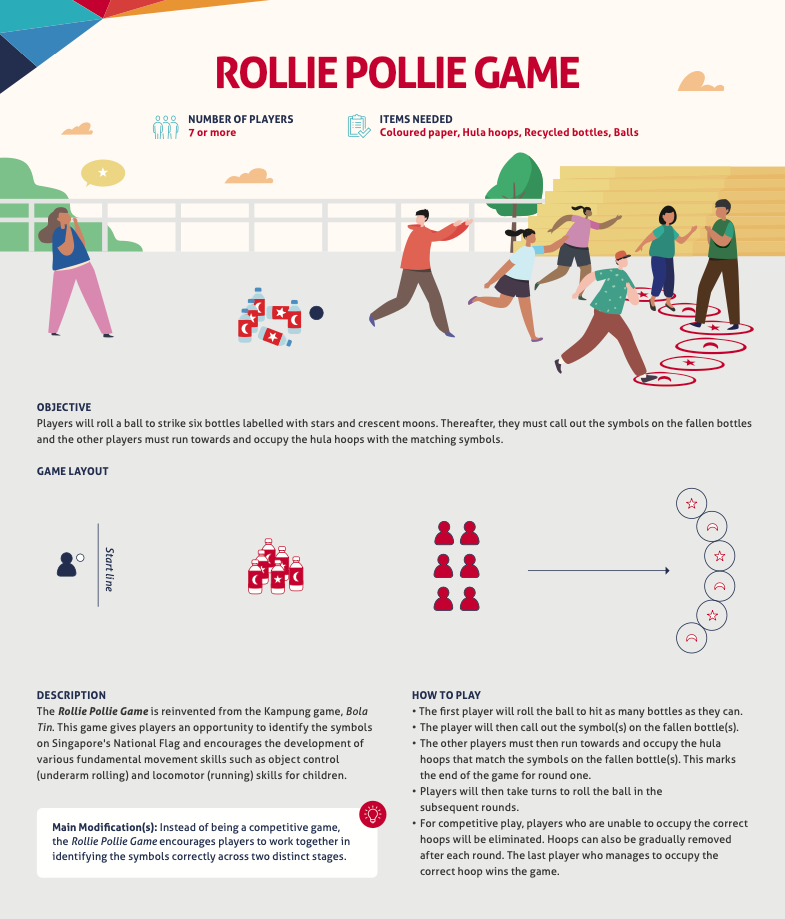
Coloured paper, Hula hoops, Recycled bottles, Balls
Objective
Players will roll a ball to strike six bottles labelled with stars and crescent moons. Thereafter, they must call out the symbols on the fallen bottles and the other players must run towards and occupy the hula hoops with the matching symbols.
Description
The Rollie Pollie Game is reinvented from the Kampung game, Bola Tin. This game gives players an opportunity to identify the symbols on Singapore's National Flag and encourages the development of various fundamental movement skills such as object control (underarm rolling) and locomotor (running, skipping) to children.
Main Modification(s):
Instead of being a competitive game, the Rollie Pollie Game encourages players to work together in identifying the symbols correctly across two distinct stages.
How to Play
- • The first player will roll the ball to hit as many bottles as they can
- • The player will then call out the symbol(s) on the fallen bottle(s)
- • The other players must run towards and occupy the hula hoops that match the symbols on the fallen bottle(s). This marks the end of game for round one
- • Players will then take turns to roll the ball in the subsequent rounds
- • For competitive play, players who are unable to occupy the correct hoops will be eliminated. Hoops can also be gradually removed after each round. The last player who manages to occupy the correct hoop wins the game
Game 3: Intergenerational Chapteh!
Number of Players
1-6 (comprising children, parents, and educators)
Items Needed
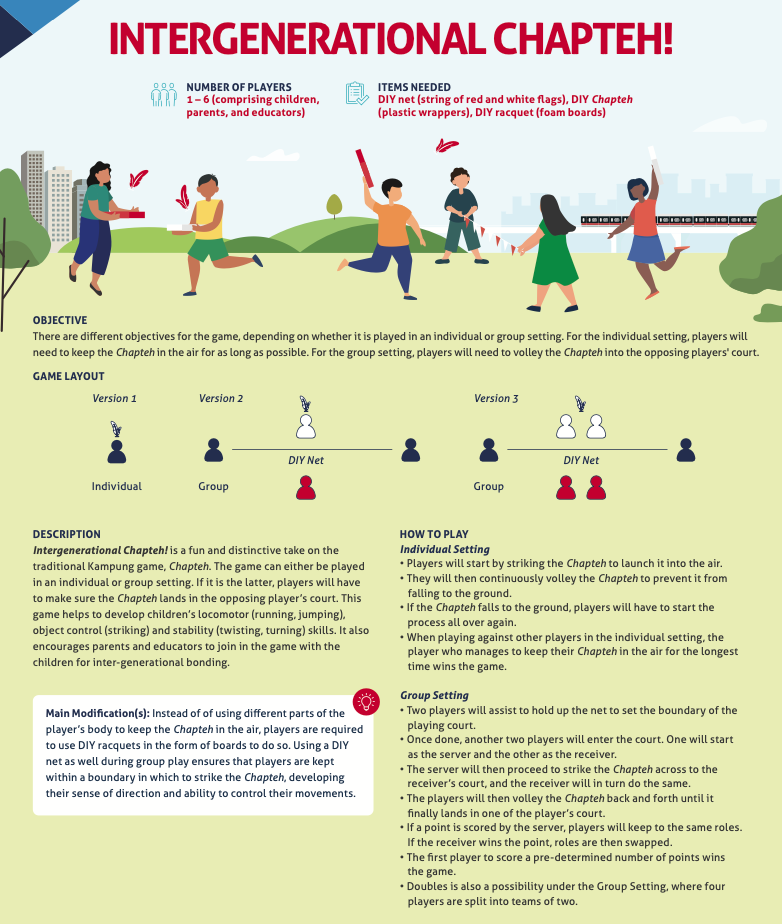
DIY net (string of red and white flags), DIY Chapteh (plastic wrappers), DIY racquet (foam boards)
Objective
There are different objectives for the game, depending on whether it is played in an individual or group setting. For the individual setting, players will need to keep the Chapteh in the air for as long as possible. For the group setting, players will need to volley the Chapteh into the opposing players' court.
Description
Intergenerational Chapteh! is a fun and distinctive take on the traditional Kampung game, Chapteh. The game can either be played in an individual or group setting. If it is the latter, players will have to make sure the Chapteh lands in the opposing player's court.
This game helps to develop children's locomotor (running, jumping), object control (striking) and stability (twisting, turning) skills. It also encourages parents and educators to join in the game with the children for inter-generational bonding.
How to Play
Individual Setting
- • Players will start by striking the Chapteh to launch it into the air
- • They will then continuously strike the Chapteh to keep it from falling to the ground
- • If the Chapteh falls to the ground, players will have to start the process all over again
- • When playing against other players in the individual setting, the player who manages to keep their Chapteh in the air for the longest time wins the game
Group Setting
- • Two players will assist to hold up the net to set the boundary of the playing court
- • Once ready, another two players will enter the court. One will start as the server and the other as the receiver
- • The server will need to strike the Chapteh across to the receiver's court, and the receiver will in turn do the same
- • The players will then volley the Chapteh back and forth until it finally lands in one of the player's court
- • If a point is scored by either player, players will then keep to the same roles. If the receiver wins the point, roles are then swapped
- • The first player to reach a pre-determined number of points wins the game
- • Doubles is also a possibility under the Group Setting, where four players are split into teams of two
Main Modification(s):
Instead of using different parts of the player's body to keep the Chapteh in the air, players are required to use DIY racquets in the form of boards (e.g., oo, oo DIY net) as well during group play ensures that players are kept within a boundary in which to control the Chapteh, developing their sense of direction and ability to control their movements.
Game 4: Bola Counting
Number of Players
6 or more
Items Needed
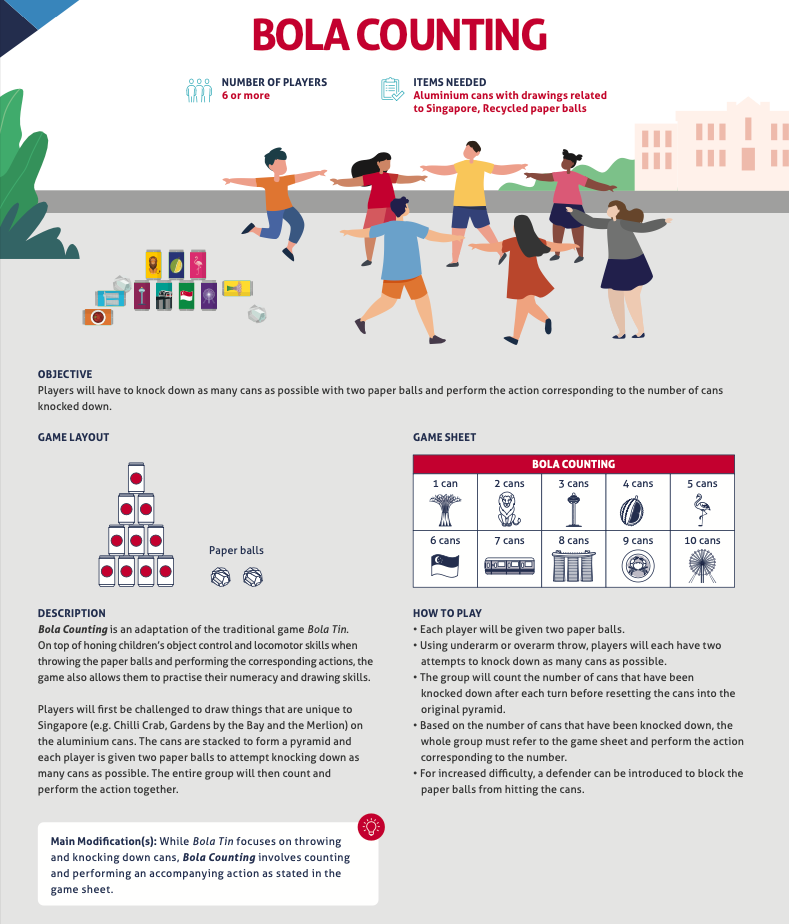
Aluminium cans with drawings related to Singapore, Recycled paper balls
Objective
Players will have to knock down as many cans as possible with two paper balls and perform the action corresponding to the number of cans knocked down.
Description
Bola Counting is an adaptation of the traditional game Bola Tin. On top of honing children's object control and locomotor skills when throwing the paper balls and performing the actions, the game also allows them to practise their numeracy and drawing skills.
Players will first be challenged to draw things that are unique to Singapore (e.g. Chilli Crab, Gardens by the Bay and the Merlion) on the aluminium cans. The cans are then stacked to form a pyramid and each player is given two paper balls to attempt knocking down as many cans as possible. The entire group will then count and perform the action together.
How to Play
- • Each player will be given two paper balls
- • Using underarm or overarm throw, players will each have two attempts to knock down as many cans as possible
- • The group will count the number of cans that have been knocked down after each turn before resetting the cans into the original pyramid
- • Based on the number of cans that have been knocked down, the whole group must refer to the game sheet and perform the action corresponding to the number
- • For increased difficulty, a defender can be introduced to block the paper balls from hitting the cans
Main Modification(s):
While Bola Tin focuses on throwing and knocking down cans, Bola Counting involves counting and performing an accompanying action as stated in the game sheet.
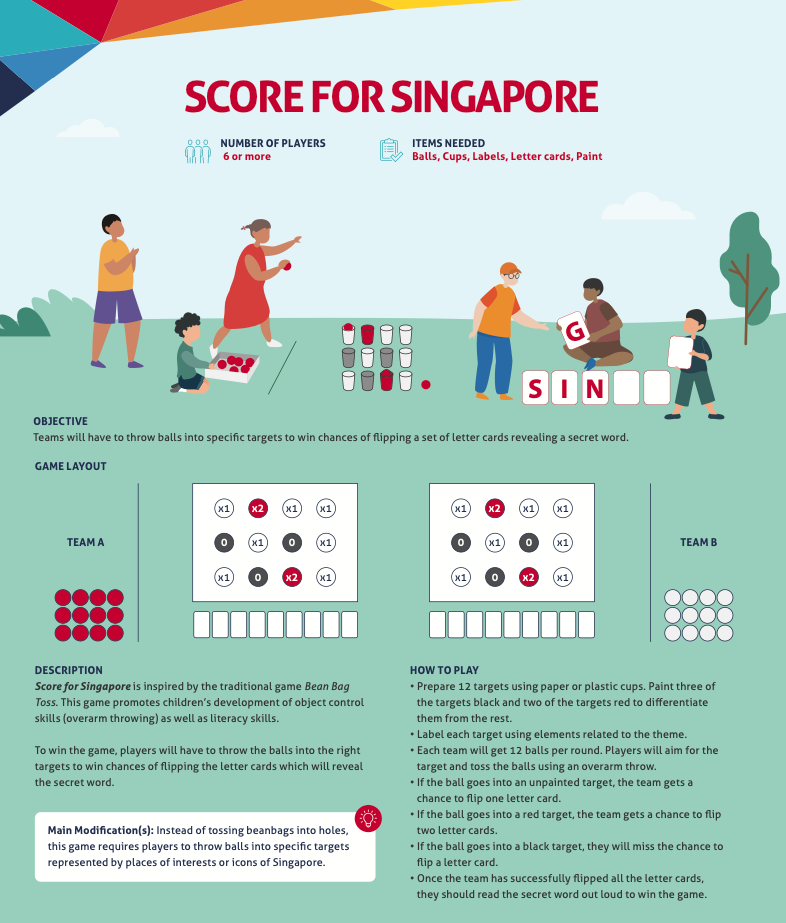
Game 5: Score for Singapore
Number of Players
6 or more
Items Needed
Balls, Cups, Labels, Letter cards, Paint
Objective
Teams will have to throw balls into specific targets to win chances of flipping a set of letter cards revealing a secret word.
Description
Score for Singapore is inspired by the traditional game Bean Bag Toss. This game promotes children's development of object control skills (overarm throw) as well as literacy skills.
To win the game, players will have to throw the balls into the right targets to win chances of flipping the letter cards which will reveal the secret word.
How to Play
- • Prepare the targets using paper or plastic cups. Paint three of the targets black and two of the targets red to differentiate them from the rest
- • Label each target using elements related to the theme
- • Each team will get 12 balls per round. Players will aim for the target and toss the balls using an overarm throw
- • If the ball goes into an unpainted target, the team gets a chance to flip one letter card
- • If the ball goes into a red target, the team gets a chance to flip two letter cards
- • If the ball goes into a black target, they will miss the chance to flip a letter card
- • Once the team has successfully flipped all the letter cards, they should read the secret word out loud to win the game
Main Modification(s):
Instead of tossing beanbags into holes, this game requires players to throw balls into specific targets represented by places of interests or icons of Singapore.