
Ultimate Frisbee
The Spirit of the Game
About Ultimate Frisbee
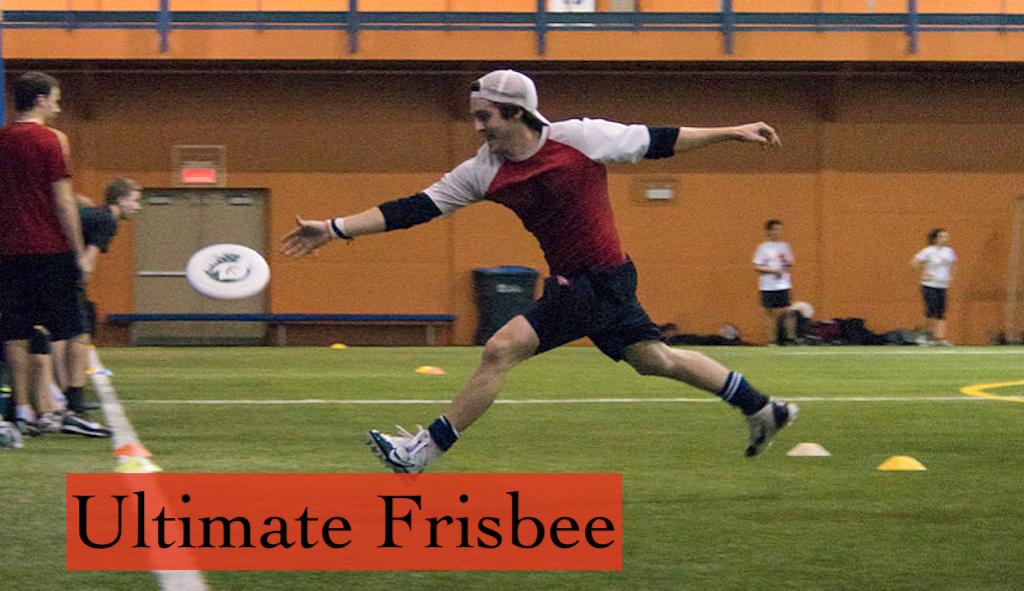
Our program will teach the fundamentals of Ultimate Frisbee. Ultimate Frisbee is a non-contact, fast-paced field sport played with two teams of seven. The object is to throw a frisbee up the field from teammate to teammate until it's caught in the opponent's endzone.
The game combines elements from other sports – the running of soccer, the jumping, pivoting, passing and continual turnovers from offence to defense of basketball, and the long bombs into the endzone of football.
Suitable For
Ages 10 and up
Duration
1-2 hours per session
Team Size
7 players per team
Equipment
All provided
Spirit of the Game
All youth and most club ultimate games are self-officiated through the "spirit of the game", often abbreviated SOTG. Spirit of the game is described by WFDF as an expectation that each player will be a good sport and play fair, as well as having high values of integrity; including "following and enforcing the rules".
"Ultimate has traditionally relied upon a spirit of sportsmanship which places the responsibility for fair play on the player. Highly competitive play is encouraged, but never at the expense of the bond of mutual respect between players, adherence to the agreed upon rules of the game, or the basic joy of play. Protection of these vital elements serves to eliminate adverse conduct from the ultimate field. Such actions as taunting of opposing players, dangerous aggression, intentional fouling, or other 'win-at-all-costs' behavior are contrary to the spirit of the game and must be avoided by all players."
Playing Field & Basic Rules
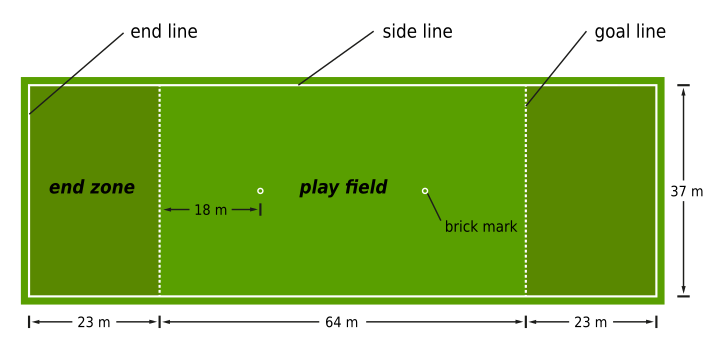
Standard Ultimate Frisbee field dimensions and layout
Scoring
A point is scored when one team catches the disc in the opposing team's end zone.
Starting Play
Each point begins with both teams lining up on the front of their respective end zone line. Standing beyond the end zone line before the disc is thrown by the defense (a "pull") to the offense is known as an "offsides" violation.
Team Composition
A regulation grass outdoor game has seven players per team. In mixed ultimate, usually it is 4-3, meaning either 4 men and 3 women at a time or 4 women and 3 men on the line.
Movement & Possession
The player holding the disc establishes a pivot point (i.e. they cannot run with the disc, just step out from a single point). They have up to three steps to slow down after catching a disc, without changing direction, to establish that pivot point. A violation of this is called a "travel".
The disc is advanced by throwing it to teammates. If a pass is incomplete, it is a "turnover" and the opposing team immediately gains possession, playing to score in the opposite direction.
Non-Contact Sport
Ultimate is non-contact. Non-incidental, play-affecting, or dangerous physical contact is not allowed. Non-incidental contact is a foul, regardless of intent.
Stall Count
The defensive "marker" counts aloud to 10 seconds, which is referred to as "stalling". If the disc has not been thrown when the defending player reaches 10, it is turned over to the other team.
Offensive Strategy & Tactics
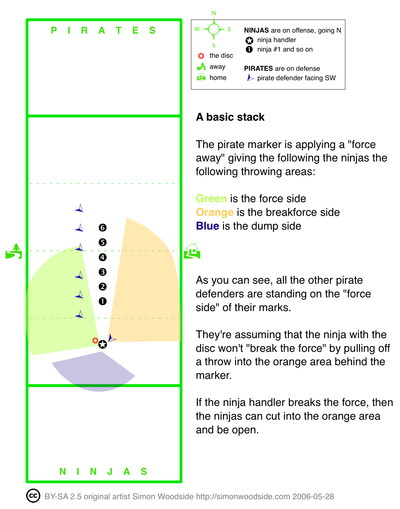
Basic stack formation and cutting lanes
Teams can employ many different offensive strategies, each with distinct goals. Most basic strategies are an attempt to create open space on the field in which the thrower and receiver can complete a pass.
Handlers and Cutters
Handlers: Players positioned around the disc, their task is to distribute the disc forward and provide easy receiving options to whoever has the disc.
Cutters: Players positioned downfield, whose job is usually to catch the disc farther afield and progress the disc through the field or score goals by catching the disc in the end zone.
Vertical Stack
One of the most common offensive strategies. A number of offensive players line up between the disc and the end zone they are attacking. From this position, players in the stack make cuts (sudden sprints) into the space available, attempting to get open and receive the disc. The stack generally lines up in the middle of the field, thereby opening up two lanes along the sidelines for cuts.
Horizontal Stack
Three "handlers" line up across the width of the field with four "cutters" downfield, spaced evenly across the field. This formation encourages cutters to attack any of the space either towards or away from the disc, granting each cutter access to the full width of the field.
Feature/German/Isolation
Three of the cutters line up deeper than usual while the remaining cutter lines up closer to the handlers. This closest cutter is known as the "feature" or "German". This strategy opens up space for the feature to cut, allowing handlers to focus all attention on only one cutter.
Hexagon or Mexican
Players spread out in equilateral triangles, creating a hexagon shape with one player in the middle. They create space for each other dynamically, aiming to keep the disc moving by taking the open pass in any direction.
Defensive Strategy & Tactics
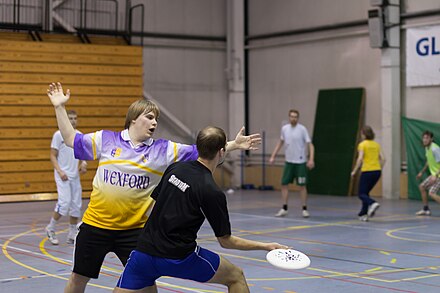
Defensive marking in action
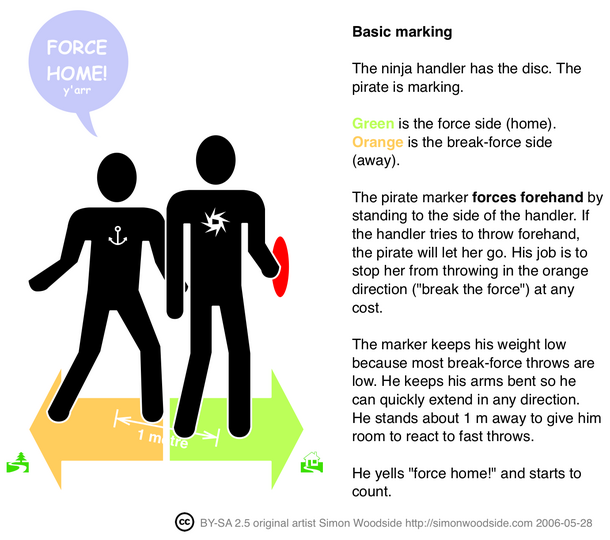
Basic marking: force and break sides
The Pull
The pull is the first throw of the game and also begins each period of play. A strong accurate pull is an important part of a defensive strategy, starting the offense as deep into their own end-zone as conditions will permit.
Force/Mark
One of the most basic defensive principles. The defender marking the thrower essentially tries to force them to throw in a particular direction (to the "force side" or "open side"), whilst making it difficult for them to throw in the opposite direction (the "break side"). The most common force is a one-way force, either towards the "home" side or "away".
Match-to-Match Defense
The simplest defensive strategy (also known as "one-to-one" or "person-to-person"), where each defender guards a specific offensive player, called their "mark". This defense creates one-to-one matchups all over the field.
Zone Defense
With a zone defensive strategy, the defenders cover an area rather than a specific person. Zone defense is frequently used in poor weather conditions, as it can pressure the offense into completing more passes. A zone usually has two components: (1) a "cup" or "wall" of players close to the disc, and (2) players spaced out further from the disc, ready to bid on overhead throws.
Cup Defense
The cup involves three players arranged in a semi-circular cup-shaped formation. One of the side players marks the handler with a force, while the other two guard the open side. The idea is to force the offense into making many short passes behind and around the cup.
Wall Defense (1-3-3)
Involves four players in the close defense. One player is the marker (also called the "rabbit", "chaser" or "puke"). The other three defenders form a horizontal "wall" or line across the field in front of the handler to stop throws to short in-cuts and prevent forward progress.
Junk/Clam Defense
A junk defense uses elements of both zone and match defenses. The most well-known is the "clam" or "chrome wall". In clam defenses, defenders cover cutting lanes rather than zones of the field or individual players. Often referred to as "bait and switch" strategy.
Our comprehensive Ultimate Frisbee programme - from fundamentals to advanced tactics
Programme Benefits
Programme Highlights
Customized Programmes Available
Contact us to tailor-make a program for you, your company, club or school. We do that weekly at affordable prices for all groups of people!
Basic Programs
Perfect for beginners learning fundamentals
Advanced Programs
Complex strategies and competitive play
Small or Large Groups
Flexible group sizes to suit your needs
One-Off or Weekly
Single activities or ongoing programs