
Field Hockey
Olympic Sport Fundamentals
Introduction to Field Hockey
Learn field hockey skills including stick handling, dribbling, passing, and shooting. Our program introduces participants to this Olympic sport through fun drills and modified games, teaching both individual skills and team play.
Overview & pointers from: http://web.uvic.ca/~thopper/iweb09/KaliCharles/Lesson_1.html
Suitable For
Ages 8 and up
Duration
1-2 hours per session
Group Size
12-24 participants
Equipment
Sticks, balls, goals provided
Lesson 1: Introduction and Ball Handling
Cognitive
Understand the rules of field hockey and apply them during mini-games
Associative
Work with classmates to help each other understand new skills and rules
Psychomotor
Hold a field hockey stick appropriately and move a ball with control
Dribble in the Space
In the designated area, move around the space getting a feel for the movement.
P1 - Follow Partner:
In pairs, follow your partner around inside the designated areas. The partner who is following has a ball and must control the ball while following their partner. The ball cannot be taken by other teams or by the partner. When the whistle blows, switch the partner in the front.
P2 - Follow the Leader:
After switching, repeat at faster pace to increase difficulty
Relay Race
Switch up pairs from last activity. In pairs, set up cones in line with demo cones. Running one at a time, in any order you choose, dribble up to cone, around it and back to your partner. Repeat, alternating partners. Each partner will do every cone.
P1 - Point Collection:
Cones are now worth points (furthest: 50, second: 20, closest: 15). In one minute, collect as many points as possible by running 360 degrees around the cone. Ball must not be further than 2 feet away from the body at one time, otherwise it's a restart.
P2 - Weave Challenge:
Pairs weave in and out of the cones and then straight back to start. Count how many times you touch the ball while dribbling through the cones. Most touches in shortest time wins.
Obstacle Course
Switch up pairs again. In pairs, using 5 pieces of equipment set up an obstacle course in 2 minutes for your partner to dribble through.
P1 - Rotate Right:
Rotate one partner to the right. The partner who remains at their course will explain it to the next student.
P2 - Rotate Left:
The partner who did not rotate the first time will now rotate, and the remaining partner will explain the new course to a new student.
Circle Game
Within a circle, dribble to maintain possession of the ball while one player tries to take your ball.
Rules:
- • Must only move within the circle
- • Attacking player cannot invade until whistle blows
- • If your ball is knocked out, you become an attacker
Lesson 2: Passing
Objective: Move to space that allows for successful passes to be made.
Shark Attack
A continuation on the follow the leader drill. Each player has a ball and moves around the space. After a 1-2 min warm up, game goes live, try to knock other player's balls out of the area. Once your ball is knocked out you are on the perimeter, you can re-enter the game if you can steal someone's ball from the sideline.
Progressions:
- • P1: Make the space smaller
- • P2: Make the space narrower so players on sideline are more involved
- • P3: Use a time limit to encourage a faster pace
Square Passing
2 groups of 4 to a grid, each group lined up at the cone diagonally across from each other. Student dribbles ball to cone in front of them and passes ball to student at the front of the other line, then feeds into that line.
Progressions:
- • P1: Have a 2 min competition between grids to see how many successful passes were made
- • P2: Use 2 balls instead of 1 (more players involved, faster pace)
- • P3: Advanced – change directions, so they have to turn to pass or rotate stick
3 vs 1 Passing Drill
4 players to a square grid. 3 passers – must stay on the perimeter. 1 defense – must have 2 hands on the stick and cannot crowd the passer. Once the perimeter player has the ball they cannot move, forcing the other 2 to get open. If 5 successful passes are made, the offenders get a point and the defender switches.
Progressions:
- • P1: Make grid smaller if it is too easy
- • P2: Make the amount of passes needed greater or less depending on difficulty
- • P3: Can only hold the ball for 2 sec to speed the game up
5 vs 3 Single Goal Game
5 are on offense, 3 on defense, rotate players through positions. This advantage allows more time to move with the ball and pass. Must make 3 passes before you can score. If ball goes out opposing team gets the ball.
Progressions:
- • P1: Make the goal smaller to encourage more movement
- • P2: Change the rules so that in order to score they must dribble through the goal
- • P3: If offense is very successful then change teams to 4v3 or 3v3
Lesson 3: Movement and Passing
Objective: Be aware of the area they are playing in, and use the space for initiating plays.
Ball Tag
Moving around the defined area, two people try to tag the third person in the area. The two people who are "it" cannot move once they have the ball in their hand. If the runner can evade being tagged for 5 passes, they get a point. If the runner is tagged, the "it" people get a point.
Make the space small if the runner is having lots of success, or make the space larger if the runner is not having much success. Try using different types of equipment if a lacrosse ball is too easy or hard.
360 Degree Field Hockey
In even teams 3v3 or 4v4, must make 3 passes before you are able to score. To score you must dribble through the cones (emphasizes dribbling). You can score on any goal, but cannot score on the same goal two times in a row. Opposing team gets the ball after a goal or when the ball goes out of bounds. The 4 goals encourages the players to use more space, limits them from clumping up.
Progressions:
- • P1: Make the space smaller so it is more difficult for the offense
- • P2: Make goals smaller
- • P3: Remove a goal if offense is scoring too easily (means they are moving to open space effectively)
Advanced Square Passing
2 groups of 4 to a grid, each group lined up at the cone diagonally across from each other. This time as the student dribbles the ball they have to weave between 2 cones, and then when at the end of the grid pass to the front of the other line, then feed into that line.
Progressions:
- • P1: Use additional cones for players to weave through
- • P2: Extend the grid
- • P3: Have a 2 min competition to see most successful passes
- • P4: Use 2 balls instead of 1
- • P5: Advanced – change directions, turn to pass or rotate stick
Sideline Challenge
Set up a rectangular grid with a goal at both ends. Two teams of 4, within the grid it is 3v3, with a player from each team on the sideline. The sideline players are always on offense, and need to be rotated out. The sideline players can use the entire length of the sideline. You must pass to a sideline player before you can score. This turns into a 5v3 game, which forces the player to use the width of the field.
Progressions:
- • P1: Must pass to both sideline players (forces use of all width)
- • P2: Make the area smaller
- • P3: Make the goals smaller
- • P4: Have a no entry crease for the offense (widens players out)
Lesson 4: Introduction to Defense and Offense
Objective: Understand the use and importance of using and moving into space.
Chinese Gates
To begin this warm up, students will start at the first individual gate, and try to make it through to the end without getting tagged. The first attempt through the gates will be done walking, both the runners and the defenders are to walk. Defenders do not have a stick. Can only be within first 2 feet of the goals they are defending.
Progressions:
- • P1: Once completed, everyone grab a stick and repeat at a faster pace
- • P2: Then everyone dribble through
- • P3: Then in pairs, pass through
5 on 4 Offense
The object of the game is to score on the single net.
Rules:
- • One person with unique colored pinny is always on offense, regardless of which team has possession
- • 3 passes must be made before the offensive team can shoot on net
- • If the ball is knocked out, the other team has possession
- • You cannot steal the ball from a player, only intercept passes
Progressions:
- • P1: The amount of passes can increase or decrease
- • P2: Allow the students to start checking the people with the ball
Target Trouble
The object of the game is to score by knocking down one of the two targets.
Rules:
- • Teams cannot enter the safe zone surrounding the target
- • If the ball is knocked out, the other team has possession
- • Teams must make 5 passes before they can shoot
Progressions:
- • P1: Increase or decrease the number of passes necessary
- • P2: May allow or not allow full checking to give the player with ball a chance to make a play
End Ball
The object of the game is to pass a ball to a teammate that is standing over the score line.
Rules:
- • Cannot move while carrying the ball
- • Cannot contact the player with the ball while on defense
- • Must make 5 passes before they can shoot
Progressions:
- • P1: Increase or decrease the number of passes depending on student's grasp
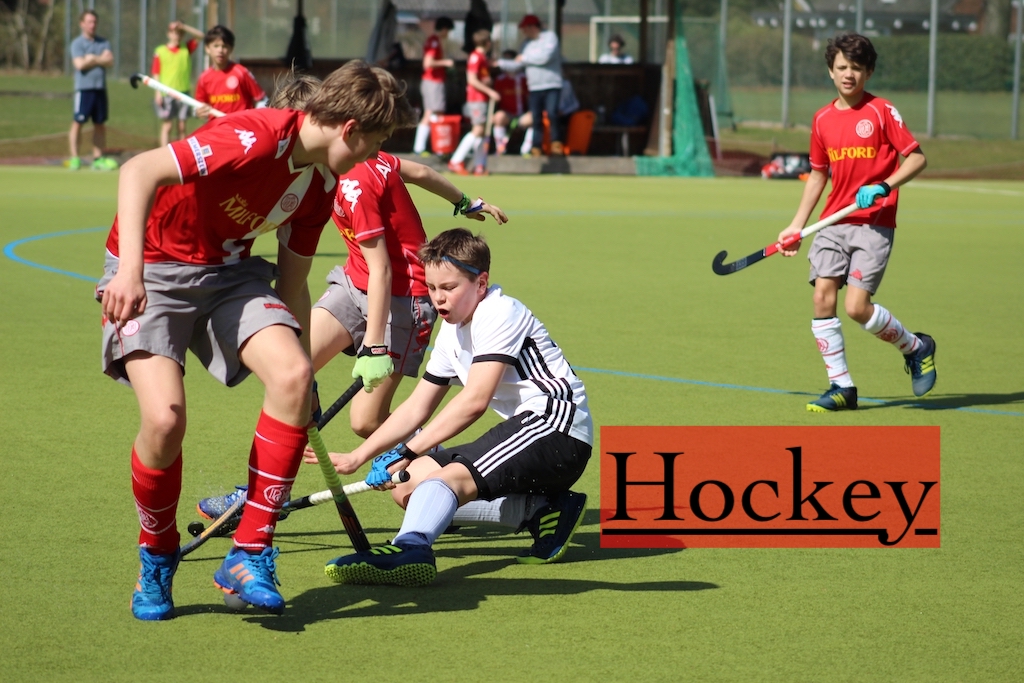
Youth field hockey training