
Pétanque
The Classic French Boules Sport
What is Pétanque?
Pétanque is a sport that falls into the category of boules sports (along with raffa, bocce, boule lyonnaise, lawn bowls, crown green bowling). In these sports, players or teams play their boules/balls towards a target ball.
In pétanque, the objective is to score points by having boules closer to the target than the opponent after all boules have been thrown. This is achieved by throwing or rolling boules closer to the small target ball, officially called a jack (cochonnet), or by hitting the opponents' boules away from the target, while standing inside a circle with both feet on the ground.
The game is normally and best played on hard dirt or gravel. It can be played in public areas in parks or in dedicated facilities called boulodromes.
Source: Wikipedia - Pétanque
Suitable For
All ages, 1v1 or teams
Duration
30-60 minutes per game
Players
1v1, 2v2, or 3v3
Equipment
All provided
Equipment & Setup
Team Composition
Pétanque is played by two teams, each comprising one, two, or three players:
- • Singles and Doubles: Each player uses three metal boules
- • Triples: Each player uses only two boules
The Boules (Metal Balls)
Competition boules must be hollow and made of metal (usually steel):
- • Diameter: 70.5 to 80 mm (2.78 to 3.15 inches)
- • Weight: 650 to 800 grams (23 to 28 ounces)
- • Various hardness levels and surface striations available
- • Leisure boules are also available for casual backyard games
The Jack (Cochonnet)
The target ball is a small wooden ball, 30 mm (1.2 inches) in diameter, traditionally made of boxwood or beechwood. The jack is known by various French names:
- • Cochonnet (piglet)
- • But (goal or target)
- • Bouchon (little ball in Provençal)
- • Le petit (the little one)
- • Gari (rat in Provençal)
The Throwing Circle
Players throw while standing in a circle (cercle) with both feet on the ground:
- • Traditional: Circle scratched in the dirt (35-50 cm diameter)
- • Modern: Red plastic prefabricated circles (50 cm inside diameter)
- • Players must remain inside with both feet on the ground while throwing
Playing Surface (Terrain)
Pétanque can be played on almost any flat, open space:
- • Best Surface: Hard dirt, gravel, decomposed granite, brick grog, or crushed sea shell
- • Public Areas: Village squares, park pathways
- • Dedicated Facilities: Boulodromes (recreational facilities built for pétanque)
- • Tournament Terrains: Marked rectangles at least 4m wide × 15m long
- • Surface may be irregular with trees, rocks, or uneven ground
How to Play
Game Objective
A game consists of several "ends" (mènes). The first team to reach 13 points wins the game. Points are scored by having boules closer to the jack than your opponent's closest boule.
Starting an End
- 1. Coin Toss: Determines which team plays first
- 2. Place Circle: Winning team places the throwing circle
- 3. Throw Jack: Player throws the jack 6-10 meters away
- 4. First Boule: Same team throws the first boule toward the jack
Order of Play
After the first boule from each team is thrown:
- • The team with the boule closest to the jack "has the point"
- • The team that does not have the point throws the next boule
- • That team continues throwing until they gain the point or run out of boules
- • If boules are equidistant, the team that threw last throws again
Scoring an End
An end is complete when both teams have thrown all their boules:
- • The team with the closest boule wins the end
- • They score one point for each boule closer than the opponent's best boule
- • Maximum possible score per end: 6 points (though 1-2 points is typical)
- • If the jack is knocked out of play ("dead"), special scoring rules apply
- • If boules are equidistant at end, neither team scores
Example:
If Team Red has 2 boules closer than Team Blue's closest boule, Team Red scores 2 points and Team Blue scores 0 points.
Starting the Next End
The team that won the previous end starts the next end by placing a circle around the jack, picking it up, and throwing it to start play again.
Throwing Techniques & Strategy
Pointing (Pointage)
Throwing the boule to come to rest in a particular spot, usually as close as possible to the jack. Players who specialize in pointing are called "pointers" (pointeurs).
Traditional maxim: "Boule devant, boule d'argent" (A ball in front is a money ball). A boule closer to the player than the jack is more valuable as it blocks opponents' access.
Shooting (Tir)
Throwing the boule to directly hit an opponent's boule to knock it away from the jack. Players skilled at shooting are called "shooters" (tireurs).
The best shot is called a "carreau" - knocking away the opponent's boule while leaving your thrown boule exactly in its place!
Traditional Throwing Technique
While boules can be thrown in any way, the traditional technique is:
- • Hold boule with palm facing downward
- • Under-arm swing ending in an upward flick of the wrist
- • This puts backspin on the boule for maximum control
- • Boule can be rolled, thrown to moderate height, or high-lobbed (portée)
Team Strategy
- • Pointers play first to get close to the jack
- • Shooters are held in reserve to knock away well-placed opponent boules
- • Good pointing scores points, but championships are dominated by skilled shooters
- • Never shoot with your team's last boule - point to limit damage
- • Players carry tape measures for measuring close points
Jack Throwing Strategy
- • Throw to a distance where your shooter is most comfortable
- • Aim for terrain locations that favor your team's pointers
- • Vary positions - don't get in a rut, alternate long and short distances
- • Disorient opponents by changing jack placement each end
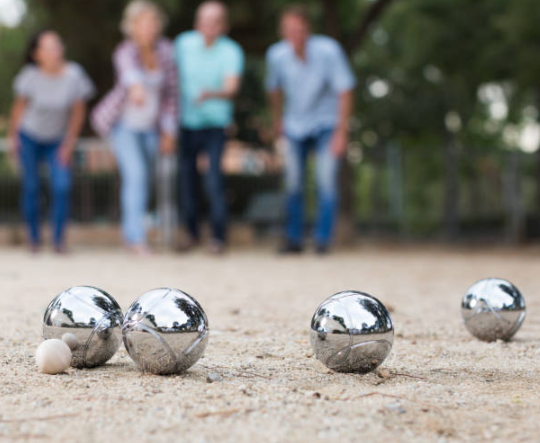
Metal boules and wooden jack (cochonnet) ready for play